Gijón P2: Lebrón / Augsburger shocked by Nieto / Sanz in straight sets
Juan Lebrón and Leo Augsburger were beaten convincingly in straight sets at the Premier Padel Gijón P2, as Coki Nieto and Jon Sanz progress.

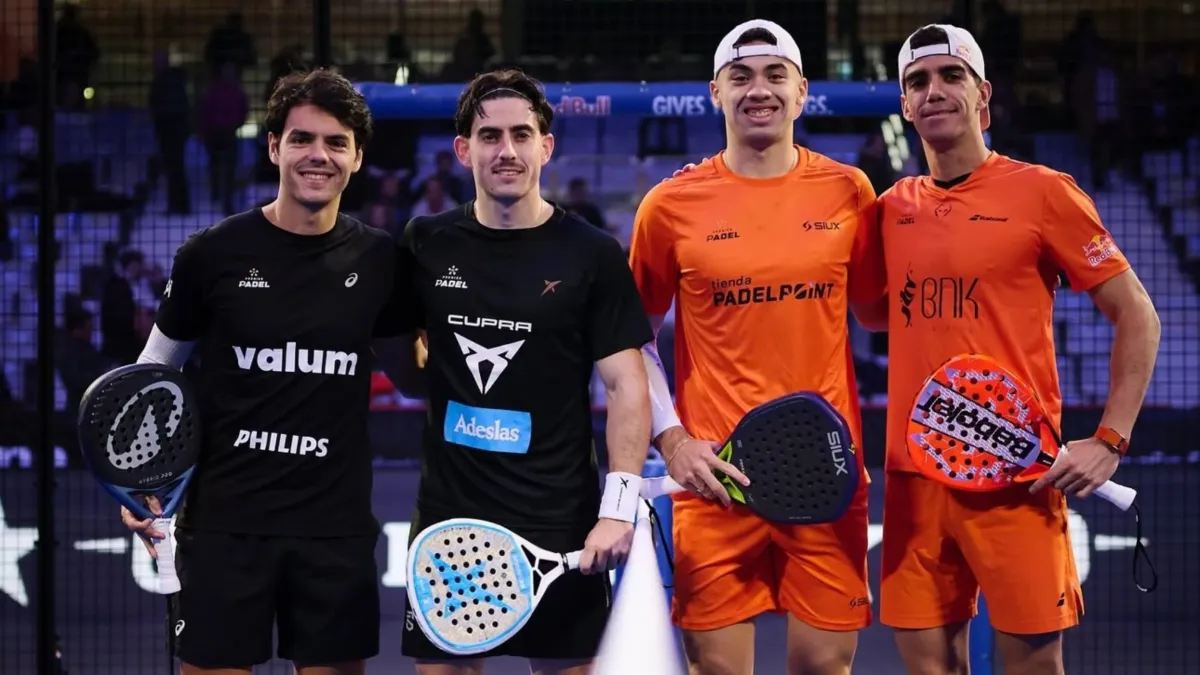
The slow courts at the Palacio de Deportes de la Guía did Lebrón and Augsburger no favours. But they didn't lose this match because of the surface.
They lost it because Jon Sanz and Coki Nieto had a specific plan, executed it with the patience of two players who have been here before, and waited for Leo Augsburger to hand them the moments that mattered.
A tactical masterclass from Nieto and Sanz
Nieto and Sanz are the kind of pair that doesn't announce themselves. There's no particularly flashy signature shot, no defining moment of individual brilliance that announces the match is being taken over.
What they do instead is construct. They grind. They identify the weak point and they return to it, repeatedly, without deviation, until the pressure becomes too much to absorb.
Augsburger weaknesses exploited
The weak point here was Augsburger, specifically his forehand block volley. The young Argentine has become one of the most talked-about players on the tour — his smash is a genuine weapon, and when the conditions suit him and the ball sits up, he can end points in ways that few others can.
But on a slow court in Gijón, those conditions arrived less frequently than he'd have wanted, and when Nieto and Sanz fed his forehand block volley with the right pace and angle, it broke down. They knew it would. They kept going back.
An MVP performance by an animated Jon Sanz
Jon Sanz's vibora deserves its own highlight reel aside from the typical match highlights.
The left-hander's aggressive, angled, wickedly awkward viboras became more potent as the match progressed, and in the tiebreak it was devastating.
Sanz's game is built on exactly the kind of high-risk, uncomfortable padel that slow courts amplify rather than neutralise: the ball stays in play longer, the angles become more pronounced, and the returns come back with less pace for him to work with on offence. In Gijón, the conditions were made for him.
The first set: Lebrón carries, Augsburger cracks
The opening set statistics look even on paper — 50% of total points each, serve percentages separated by only five percentage points (70% to 65%), a set that the numbers suggest was nip and tuck throughout.
It wasn't quite that. There were passages where Lebrón looked like the best player on court, dragging his partnership through difficult moments with the kind of competitive intensity that made him a former world number one.
When Augsburger was misfiring, Lebrón was the one keeping them in games, winning points through individual quality rather than collective construction.
The problem was the moments when individual quality wasn't enough. At 5-6 down in the first set, Augsburger produced two errors that were, in the context of a tight set, simply unacceptable at this level.
A lob that drifted long — not under any particular pressure, not forced by anything Nieto or Sanz had done — and then a backhand volley into the net from a position where he had time and space. Two unforced errors, two gifts, and the first set was gone.
In slow court conditions, you cannot donate points to Nieto and Sanz. They will accept the gift graciously and bank it.
The Lebrón / Augsburger partnership failed the stress-test
If there's one team you want to come up against to test your levels, and to stress test resilience of a partnership, it's Coki Nieto and Jon Sanz.
The second set was tighter, but it felt like Nieto and Sanz could win points whenever they needed to, especially in the big moments.
This is reflected by Lebrón and Augsburger winning 48% of total points across the match, so close to parity that the outcome feels almost arbitrary when you look at the data in isolation.
It wasn't arbitrary. Across both sets, Lebrón and Augsburger managed only 31% of return points won, and their first return points figure sat at just 28% for the match.
Against a pair as structured as Nieto and Sanz, being unable to convert on return means you are always playing from a deficit, and putting immense pressure to hold your serve.
Slow court conditions, but not for Jon Sanz
In a match featuring both Lebrón and Augsburger, two of the finest smashes on tour, it would surprise to those who didn't watch this tie that it was in fact Jon Sanz's smash that stole the show.
Sanz was returning the ball to his side with ease, when given the chance.
But despite having the best smash of the game, this wasn't Sanz's most potent weapon of the match.
Sanz's vibora was venomous, Lebrón and Augsburger had to adapt their tactics to simply come forward to block the ball. But every time they did that, Sanz's viboras got more powerful, with more spin.
The tiebreak was really where Sanz's vibora took over. In a tiebreak, every point is stripped of the context that protects you during a game — there are no more games to absorb a bad point, no coming back from a mini-break.
Are the cracks showing already for Lebrón and Augsburger?
It is only the second tournament of the season, and Lebrón and Augsburger have gone from being one of the in-form teams at the Riyadh P1, to being knocked out in the Gijón P2 QF.
A win would've took the pair to the semi-finals to match up against Lebrón's former teammate, Ale Galán and Fede Chingotto.
That Lebrón, by the end of the first set, was visibly frustrated with his partner is not a surprise to anyone who watched him play with Stupaczuk last season.
The final two points of the match were Augsburger errors, a lob that went deep and a block volley into the net. Sound familiar? It was the exact two errors that gave the first set to Sanz and Nieto.
We've been here before with Lebrón, is it different this time?
The pairing of Lebrón and Augsburger already has an air of déjà vu about it. An elite player with extraordinarily high standards, a younger partner feeling the weight of those standards in the moments that matter most, and mistakes arriving precisely when they can least be afforded.
Whether the pressure Lebrón places on those around him – implicit, unspoken, but unmistakable – contributed to Augsburger's late-match errors is impossible to say with certainty. But it's impossible to watch and not wonder.
If this partnership lasts the season, it will be because Augsburger understands the pressure of playing with legend of the game, and works hard to improve the weaknesses in his game that are quite obviously being exploited in vital moments in the match.
Nieto's return marked with a huge performance
This was Coki Nieto's seasonal debut in Gijón, having missed the Riyadh P1 through injury. He and Sanz came through two three-set matches just to reach the quarter-finals, arriving at this tie with considerably more mileage in their legs than Lebrón and Augsburger.
That they won it in straight sets — efficiently, without drama, exactly on their own terms — says something about their quality as a partnership. They were 2024 Finals champions in Barcelona. They know how to close.
Lebrón and Augsburger will reflect on a match they were close enough to winning that the details feel particularly painful. The errors at 5-6 in the first set. The forehand block volley that kept breaking down. The tiebreak that Sanz controlled from the first point.
Match stats: Sanz / Nieto vs Lebrón / Augsburger
Lebrón / Augsburger
Sanz / Nieto
What happed elsewhere at the Gijón P2?
Elsewhere on Friday, the women's quarter-finals also produced a notable result as Sofia Araújo and Claudia Fernández fell to Icardo and Jensen.
In the other half of the women's draw, Paula Josemaría and Bea González booked their semi-final place — where they will face Josemaría's former partner Ariana Sánchez, now partnered with Andrea Ustero. That one has a story of its own.
In the men's draw, Nieto and Sanz advance. The Wolf exits. And the slow courts of Gijón claimed one of the more compelling casualties of the season so far.