Juan Lebrón's record vs. Coello & Tapia: Can El Lobo ever get back to World No. 1?
Can Juan Lebrón get back to the pinnacle of padel, and become World No. 1 once more? We take a look at El Lobo's record against Coello & Tapia.

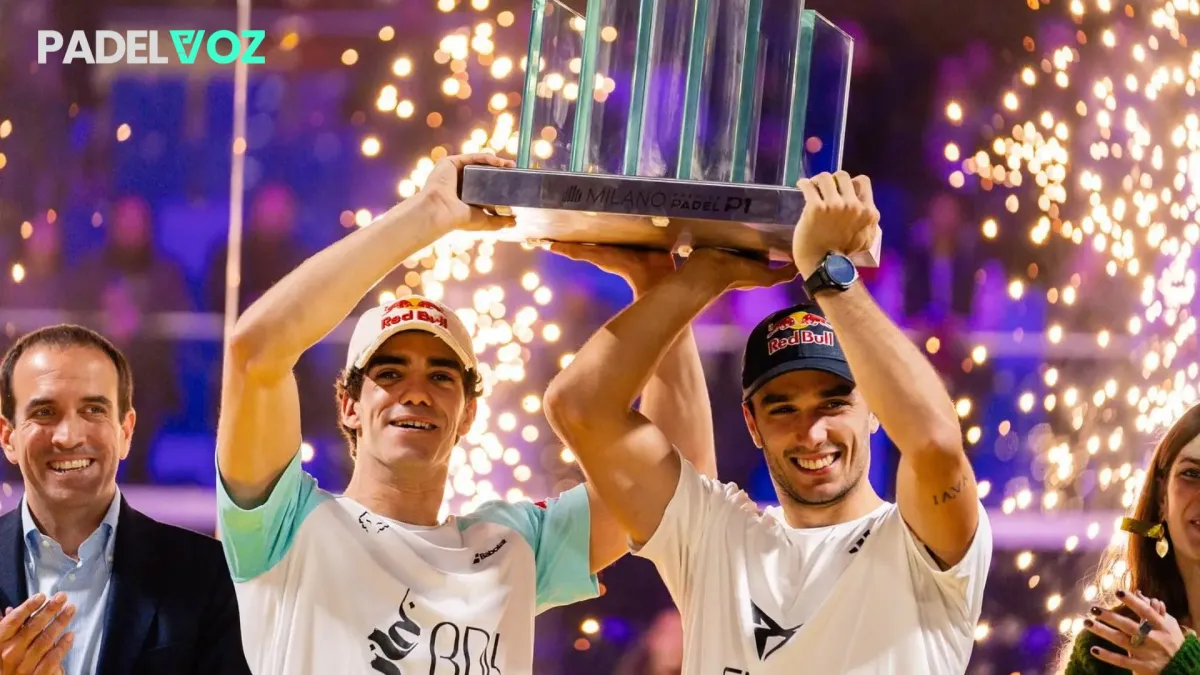
There are rivalries defined by emotion, and others defined by inevitability. Juan Lebrón’s record against Arturo Coello and Agustín Tapia increasingly belongs to the latter category — not because he cannot beat them, but because the margins of how he does or doesn’t have become brutally clear.
Ahead of the Riyadh P1 semi-final, where Lebrón and Leo Augsburger will face the world No.1s, the historical data paints a picture not of decline, but of tactical misalignment.
This is not about hunger. It is about geometry, tactics, and chemistry with his partner.
Lebrón's biggest challenge to getting back to his best is finding a partner that can bring the best out of him, both tactically and mentally.
The Ale Galán era
Lebrón and Galán were undoubtedly a formidable force in the game before their breakup in March 2024.
The Riyadh P1 would be their penultimate tournament together, and despite tensions between the pairing, Lebrón and Galán would defeat Coello and Tapia comfortably that day.
Lebrón’s most competitive stretch came alongside Galán, not because they out-hit Coello/Tapia, but because they had the technical ability to execute precise tactical plans to disrupt Tapia’s rhythm, and to limit Coello's attacking power.
They targeted Tapia’s backhand return with height, not pace, whilst Galán absorbed a lot of pressure in defensive positions, allowing Lebrón's creativity to shine in key moments.
Juan Lebrón's record in recent seasons has been hit-and-miss against Coello and Tapia. Lebrón only has a 33% win-rate (2 wins, 6 losses) in finals, and a 50% win-rate (2 wins, 4 losses) in semi-finals against Coello and Tapia.
The later the round and the higher the stakes, the more Coello/Tapia impose structure and dominance against Lebrón.
The Franco Stupaczuk era
The Stupa/Lebrón pairing struggled to narrow the margins required to beat Coello/Tapia.
Stupa struggled with consistency in key pressure moments, and at times seemed to crumble under the intense scrutiny of Juan Lebrón.
One of Lebrón's shortcomings as an elite athlete in a team sport is his empathetic approach to supporting his teammates.
When the pressure builds, Lebrón's addiction to winning takes over, and the expectations and demands that he puts on his partner become huge.
Across six meetings, Stupa/Lebrón only managed 1 win against Coello and Tapia, suffering 5 losses in the process. Most matches lost in straight sets, demonstrating complete dominance from the World Number Ones.
In the Riyadh P1 2025 final (match ID 156), Lebrón/Stupa lost 6-3, 7-5, 6-3. They actually won the second set by increasing lob depth to Tapia's backhand, but couldn’t sustain pressure once Tapia adjusted position and started taking producing overheads.
Why Coello/Tapia are a unique problem for Lebrón
Whilst Lebron has also struggled against his former partner, Ale Galán, a lot of that can be put down to the fact that Galán has developed his game tenfold (specifically his consistency when defending from the back).
You can also throw in to the discussion that Galán seems to get into the head of Juan Lebrón when they play with one-another, with no love lost amongst the former partners who would win 33 titles together.
But Coello and Tapia are a unique problem for Lebrón. El Lobo excels when he is able to mix his defensive solidity with transitional creativity.
Tactically, Coello and Tapia refuse to allow Lebrón to gain momentum in game.
They nullify the threats of Lebrón, and restrict his ability to impact the game by focussing on his partner, or by only switching to Lebrón's side on easy balls.
This was incredibly evident when Stupa was Lebrón's partner, Coello and Tapia who prefer to face the consequences of lobbing Stupa and risking receiving a punishing rulo in return, as opposed to allowing to dictate the game with his world class kick-smash.
Coello and Tapia do three things relentlessly when they face Lebrón:
- Pin Lebrón to the right fence, forcing him to defend diagonally rather than attack straight.
- Avoiding playing to Lebrón when returning serve, thus neutralising Lebrón’s instinct to finish early or to put pressure with his wide-range of volleys.
- Focus on playing to the left shoulder of Lebrón's partner, which allows them to open up space across the court.
When Lebrón’s teams lose, they lose quietly — not through errors, but through erosion.
The Leo Augsburger era
This is why the Riyadh P1 semi-final is fascinating.
Leo Augsburger is closer to Galán in style than Stupaczuk. He is volatile, aggressive, and on his day, unstoppable aerially.
His ability to execute high-risk overheads, mainly kick-smashes, drastically reduces the amount of space for Coello and Tapia to play in.
It's safe to say that teams preyed on lobs to Stupa's backhand, but with Augsburger in position, Coello and Tapia may quickly find that their out-ball will have to be on Lebrón.
Augsburger is still developing as a player, and he will inevitably transition into a more well-rounded playing (specifically defensively), akin to what we've seen from Galán and Coello in recent years.
But Augsburger's high-risk style, on his day, can be the deciding factor in matches, especially against the world number ones. Tapia must defend more overheads, Coello will have to play more on Lebrón, and Lebrón will be able to influence the game by getting more touches of the ball overall.
But it also introduces danger...
Augsburger’s error tolerance is lower. His decision-making is faster — sometimes too fast.
Against a pair that thrives on patience, that is both his weapon and weakness.
This is not a rivalry slipping away from Juan Lebrón. It is one that has evolved beyond instinct and into systems and tactics.
Augsburger could be the secret ingredient to titles for Lebrón this year, providing that El Lobo can support his partner with positivity, and impart confidence in Augsburger's high-risk approach to padel, especially in decisive moments.
Padelvoz is an independent padel news platform, dedicated to bringing you closer to the padel action with a voice that speaks your language.