Ari Sanchez and Andrea Ustero announce new pairing for the 2026 Premier Padel Tour
After five legendary seasons with Paula Josemaría, Ari Sánchez bets on 18-year-old prodigy Andrea Ustero in an all-Catalan partnership that aims to reclaim the throne.

When Ariadna Sánchez and Paula Josemaría announced their separation in December, ending one of the most successful partnerships in padel history, the immediate question became: what next? For Sánchez, a 28-year-old former world number one with 44 career titles, the answer arrived in the form of Andrea Ustero—a left-handed 18-year-old from Barcelona who represents both the present and future of Spanish women's padel.
The partnership, branded "From Barcelona to the world" and officially confirmed in mid-January, pairs Sánchez's championship experience with Ustero's explosive youth. As the number three seeds entering the 2026 Premier Padel season with 21,345 combined points, they begin their competitive journey at the Riyadh Season P1 carrying significant expectations and intriguing questions about how their divergent career stages will mesh.
Ari Sánchez: The Architect Seeks Reconstruction
Sánchez's 2025 season ended in bittersweet fashion. Alongside Josemaría, she captured six Premier Padel titles and €273,000 in prize money, maintaining their status as one of the circuit's elite combinations. Yet for a player accustomed to residing at number one—a position she held for consecutive seasons in 2023 and 2024—finishing 2025 outside the top ranking represented a departure from her own standards of excellence.
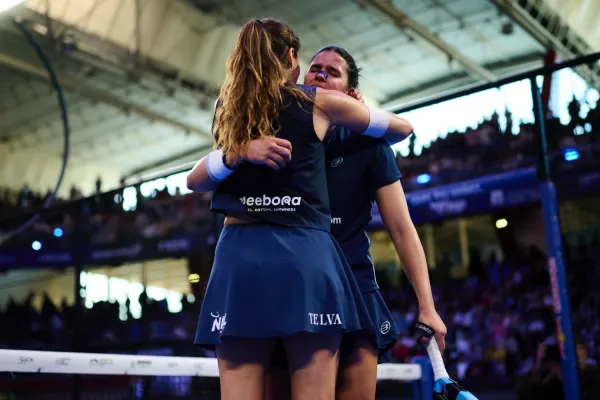
The Barcelona Finals provided an emotional coda. In their penultimate match together, Sánchez and Josemaría defeated Alejandra Salazar and Martina Calvo in a tense semi-final, with Sánchez reflecting afterward on their legacy: "We're still not fully aware of everything we've achieved together. When Sunday is over, I think we'll look back and feel incredibly proud of what we've done."
That Sunday brought a third-place finish after losing the bronze medal match, a result that felt anticlimactic for a partnership of such historic significance. But more importantly, it closed a chapter and opened a new one—built this time around a very different profile of partner.
Sánchez's game has always centered on tactical intelligence and defensive excellence. Playing from the backhand side, she excels at reading opponents, managing tempo, and creating the conditions for her partner to attack. Her volleys are precise rather than powerful, her court positioning exemplary, her decision-making consistently sound under pressure. She orchestrates; her partners execute.
This model worked to perfection with Josemaría, whose explosive right-handed power provided the finishing punch to Sánchez's careful construction. The question entering 2026 is whether Ustero can fill that role with comparable effectiveness—and whether their age difference becomes an asset or liability under pressure.
Andrea Ustero: Prodigy Under Pressure
At 18, Ustero is already the youngest player in the world's top ten. Her 2025 season alongside Sofía Araújo announced her arrival among the elite: eleven semi-finals, victory at the Bordeaux P2, and a consistent level of performance that earned her third-seed status entering 2026.
The defining moment of her breakout came in October 2024, when at just 17 years old, she became the youngest player ever to reach a Premier Padel final during the Paris Major. That achievement, combined with three Spanish championships and four Catalan titles in junior categories, established her credentials as one of Spanish padel's most promising talents.
Ustero's playing style mirrors the profile that made Josemaría such an effective partner for Sánchez. A natural left-hander with explosive power, she possesses the ability to finish points decisively from the drive side. Her smashes carry genuine threat, her net play continues to develop, and her athletic ability allows her to cover court effectively.
"She's a very young player, with a lot of desire," Sánchez said of her new partner. "She's looking for some experience from me, and I can help her find the right path. What I appreciate most is her youth and ambition."
For Ustero, the opportunity represents a quantum leap in her career trajectory. Speaking about the partnership, she noted: "What strikes me most is how professional she is and the way she supports me on a daily basis. She's a true number one."
The partnership required immediate and significant commitments from Ustero. She parted ways with her coach Pablo Aymá and physical trainer Sergi Valldaura, integrating fully into Ángel González's system—the same coach who guided Sánchez to her previous successes. This structural alignment signals Sánchez's intention to build not just a competitive partnership but a comprehensive professional project designed for sustained excellence.
Tactical Synergies and Strategic Imperatives
The Sánchez/Ustero combination follows a proven template in women's padel: experienced right-hander managing tempo and tactics, explosive left-hander delivering finishing power. It's the model that brought Sánchez two world number one finishes with Josemaría, and it's the foundation she's returning to with a younger, perhaps rawer, but undeniably talented collaborator.
Defensive Solidity: Sánchez's ability to neutralize opponent attacks creates the platform from which Ustero can counter-punch. Her reading of lobs, volleys, and defensive positioning should provide the younger player with opportunities to attack from advantageous positions.
Left-Right Balance: The left-handed/right-handed combination offers tactical versatility, particularly in serving patterns and in creating awkward angles for opponents. Ustero's natural southpaw advantage on the drive side complements Sánchez's right-handed precision on the backhand.
Experience Transfer: Perhaps most critically, Sánchez brings championship-level knowledge of managing pressure situations, crucial match moments, and the psychological demands of competing for titles. For Ustero, the education will be invaluable—if she can absorb and apply it under competitive stress.
The primary question mark centers on consistency. Ustero, for all her talent, has yet to demonstrate the week-in, week-out reliability that championship contention demands. Her 2025 season featured eleven semi-finals but also periods of vulnerability. With Araújo, she benefited from patience and structured development. With Sánchez, the expectations—and pressure—will be considerably higher.
The Pre-Season Signals
Early returns have been promising. During the Hexagon Cup in late January—an exhibition team event that provided the first glimpses of new partnerships—Sánchez and Ustero impressed with their authority. Facing Marta Ortega and Gemma Triay under the Rafael Nadal Academy colors, they prevailed 6-2, 6-3, displaying tactical cohesion and complementary strengths that suggested their partnership might gel more quickly than anticipated.
"Tactically sound and (already) very complementary," was how observers described their performance. The chemistry appeared natural, the role delineation clear, and most importantly, the competitive edge sharp.
A subsequent 6-3, 6-3 victory over another formidable pairing reinforced the impression that Sánchez and Ustero had done their homework during the off-season. The question is whether exhibition success translates to ranking-point pressure in Riyadh and beyond.
The Pressure Equation
Ustero's youth presents both advantage and vulnerability. At 18, she plays with the fearlessness that comes from limited exposure to career-defining defeats. She hasn't accumulated the scar tissue that sometimes makes veteran players tentative in crucial moments. This could prove liberating, allowing her to attack without overthinking consequences.
Conversely, partnering with a former world number one creates expectations that might overwhelm a player still developing her competitive identity. Sánchez will inevitably compare Ustero's performances—consciously or unconsciously—to Josemaría's contributions in similar situations. Can the teenager handle that implicit pressure while also managing the explicit demands of competing at padel's highest level?
Sánchez, for her part, faces her own pressures. At 28, she's hardly ancient by padel standards, but the sport favors youth and athleticism. Her window for reclaiming number one status is finite, and she's bet her immediate future on a player who, despite her obvious talent, has never carried the weight of championship expectations.
"This partnership is not a gamble on the future: it's an immediate project, a pair designed to perform from the very first tournaments of 2026," one analyst noted. That urgency defines their challenge—and possibly their vulnerability.
The Catalan Connection
The all-Barcelona nature of the partnership carries symbolic weight in Spanish padel circles. Both players train in Catalonia, share the same equipment sponsor (HEAD), and can maintain regular contact without the logistical complications that plagued Sánchez's previous arrangement (Josemaría trained in Alicante at the Juan Carlos Ferrero Academy).
This geographical proximity facilitates not just training coordination but relationship building—the off-court chemistry that often proves as important as on-court tactics in successful partnerships. Early social media content suggests genuine mutual affection and respect, foundations that could prove crucial when results inevitably fluctuate.
The Road Through Riyadh
The Riyadh Season P1 presents an immediate test. As number three seeds, Sánchez and Ustero should navigate early rounds without meeting top-tier opposition, allowing them to build rhythm and confidence. However, the deep women's draw means dangerous opponents lurk at every turn.
The most intriguing potential matchup would be a meeting with González and Josemaría—Sánchez facing her former partner with her new project. The emotional dynamics alone would be fascinating, but the tactical battle would be equally compelling: Sánchez's defensive mastery and Ustero's youth against the dual-offensive firepower of González and Josemaría.
Beyond Riyadh, the season stretches through 26 tournaments across 18 countries, a grueling schedule that will test both Ustero's physical resilience and the partnership's ability to maintain form over extended competition. For a teenage player stepping up to number-three-seed expectations, the demands will be considerable.
The Verdict Still Pending
Sánchez and Ustero enter 2026 as perhaps the season's most intriguing variable. They possess the tools to challenge for titles—Sánchez's championship pedigree and tactical acumen paired with Ustero's explosive potential and athletic gifts. Their early chemistry appears genuine, their role definition clear, and their mutual commitment evident.
Yet questions remain. Can Ustero handle the pressure of partnering a legend? Will Sánchez's experience prove sufficient to compensate for any consistency gaps from her younger partner? And can a partnership built on contrasting career stages achieve the sustained excellence necessary to challenge Triay/Brea and the explosive González/Josemaría combination?
The answers begin to emerge in Riyadh, where youth and experience unite in pursuit of a shared ambition: reclaiming the summit of women's padel.
The Riyadh Season P1 runs from February 9-14, 2026, with qualifying rounds beginning February 7. Full coverage available on Red Bull TV.