Explained: Why are Ale Galán and Leo Augsburger feuding?
'He's nothing special': Leo Augsburger on Ale Galán. We break down what was said, why it matters, and what it tells us about the sport's generational shift.

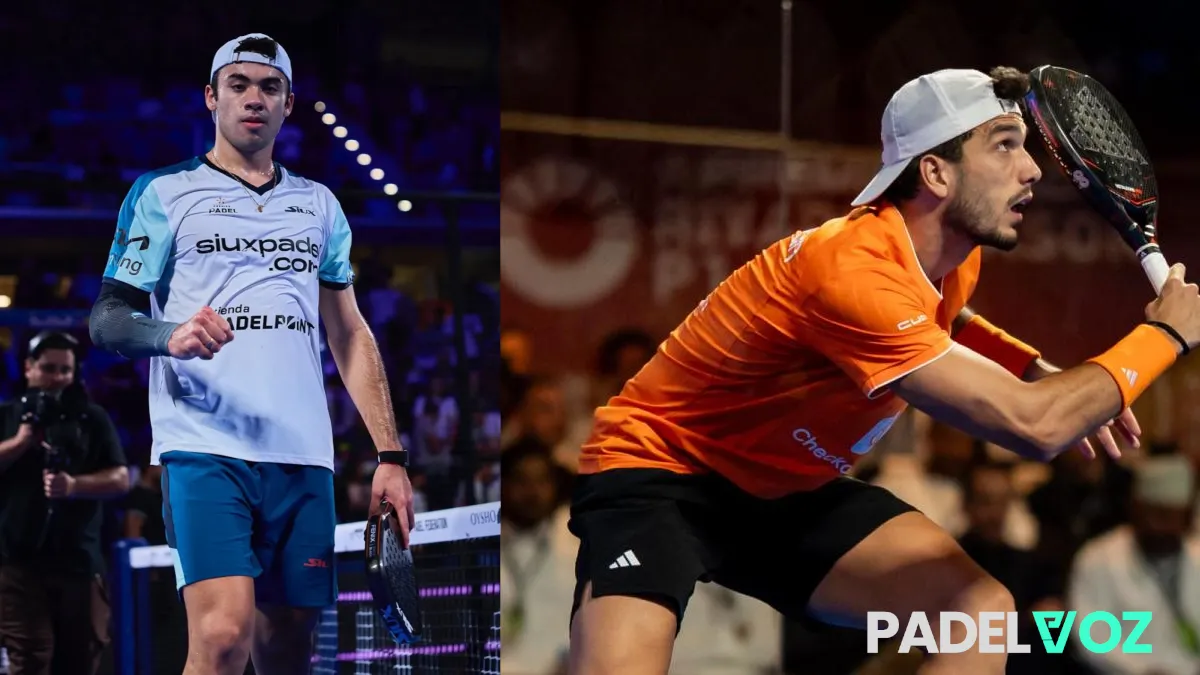
Before Alejandro Galán stepped off the Gijón court last week, still breathing hard after a gruelling 4-6, 6-3, 6-4 semifinal victory, a journalist was already waiting with a question that had nothing to do with the match.
It was about Leo Augsburger. And what Augsburger had said about him.
Galán answered calmly. Of course he did.
But why exactly did the 21-year-old from Posadas, Misiones, decide to publicly dismiss one of the sport's most decorated players in Ale Galán?
What was said
The spark came during an interview at the Gijón Premier Padel P2, conducted by journalist Joaquín Serna. Augsburger, seeded fourth and partnering Juan Lebrón, was asked about Galán — specifically about comparisons between the Spaniard and Agustín Tapia, widely considered the gold standard of modern padel.
Augsburger did not hedge.
"What sets us apart is his experience. To be honest, I don't really watch Galán, I'm not a big fan, he's nothing special."
The quotes spread quickly. By padel standards, this was incendiary. Galán is not merely a decorated player — he is a three-time world number one, a former FIP World Champion, and one of the architects of the professional game's commercial rise. To call him 'nothing special' is either an act of spectacular disrespect or a very calculated piece of competitive theatre.
Possibly both.
How did Galán respond?
Galán addressed the controversy after his semifinal win over Jon Sanz and Coki Nieto — a match he and partner Federico Chingotto had to fight tooth-and-nail to close out. He was measured. He was, if anything, generous.
"He's a great guy, but I feel he's had a very bad environment for a long time."
That reference to Augsburger's environment — understood to be directed at the player's agent — was Galán's sharpest jab. Not at Leo personally, but at those around him. It acknowledged talent while questioning the influences shaping him.
He continued:
"Leo is an ambitious and competitive player who likes confrontation. I think it's a tactic of his to motivate himself. That's all there is to it."
And then, in a moment that said more than any pointed response could:
"I'm not holding it against him. We've known each other for a long time, and I wish him all the best. He's going to be a great player; who knows, maybe years from now I'll have to call him for help."
Smiled as he said it, apparently.
Who is Leo Augsburger?
If you need reminding: Leo Augsburger, born August 11, 2004 in Posadas, Misiones, is already ranked inside the FIP top ten at 21 years of age.
He left school at 14 to pursue padel full-time — his parents own a padel complex in his home city — relocated to Spain at 17 to train with the Nox Academy, and made his name with former partner Tino Libaak on the old WPT circuit.
The 2024 World Championship was his breakout moment on the global stage. He and Libaak delivered Argentina's decisive point in the men's final against Spain's Navarro and Yanguas, winning a brutal three-set decider 3-6, 7-5, 7-6. A world title at 19. Not a bad audition.
The following season brought further evidence of elite potential. With Pablo Cardona as partner — the two Spanish-Argentine 2004-born prospects representing something of a 'terrible twins' dynamic — Augsburger helped shock Galán and Chingotto in the Riyadh P1 quarterfinals, 6-3, 4-6, 6-3. He reached the Madrid P1 final alongside Martín Di Nenno and won his first Premier Padel title, beating the world number ones Tapia and Coello.
Who is Ale Galán?
Alejandro Galán Romo was born in Madrid on May 15, 1996. He grew up in Leganés, in a modest household, learning padel on the court in the urbanisation where his family lived. He could only afford to train once a week as a child. A scholarship from coach Jorge Martínez changed the trajectory.
His professional debut came in 2016, and his ascent thereafter was relentless. Three consecutive years — 2020, 2021, 2022 — as world number one alongside Juan Lebrón. He is also the current president of the Professional Padel Players Association, a position that places him at the heart of how the sport governs itself.
Since partnering with Federico Chingotto — a pairing known in the game as 'Chingalán' — Galán has remained in the top echelon. They reached the final of the Gijón P2, where they ultimately overcame Tapia and Coello 7-5, 7-6 to claim the title and cut the points gap at the top of the rankings. Their H2H against Tapia and Coello heading into Gijón stood at 10-17 — not a dominant record, but the result underscored that Galán remains a genuine title contender at 29.
THE CONTEXT: A SPORT IN GENERATIONAL FLUX
Padel in 2026 is a sport navigating its own version of old guard versus new wave. Tapia and Coello, both in their mid-twenties, have already made the top of the rankings their own. Augsburger, Cardona, Libaak — this generation of players born around 2004 — is arriving with something to prove and little appetite for deference.
Augsburger has been characterised by coaches and observers alike as someone who plays, and talks, entirely on his own terms. Seba Nerone, his former coach, summed it up: "When he wins, he wins with his ideas. And when he loses, he loses with his ideas too." There is respect embedded in that observation, and a warning.
Galán, for his part, is not misreading what is happening. By framing Augsburger's comments as a motivational tactic, he is being astute. He does not escalate. He does not get drawn into a back-and-forth that only benefits the younger player.
The two will almost certainly meet on court before the season is out. Augsburger and Lebrón were eliminated in the Gijón quarterfinals by Nieto and Sanz — the same pair Galán and Chingotto had to dig deep to overcome in the semis. The bracket spared them this time.
Stay up-to-date with all the latest Premier Padel Tour news by signing up to the Padelvoz newsletter below.
PADELVOZ
The voice of padel news.